
Datawarehouse Implementation Support
Recommended for organizations that:
- Require system modifications or development each time they respond to EU regulatory requirements or prepare reports for regulatory authorities
- Are highly dependent on the IT department or external vendors, resulting in slow response times and high costs
- Have fragmented data across European entities, making cross-functional analysis and centralised management difficult
What is Datawarehouse Implementation Support?
A data warehouse is a database system that centrally manages data collected from multiple business systems, enabling cross-system analysis and effective data utilisation.We provide end-to-end support for data warehouse initiatives—from upstream design and implementation through to post-implementation adoption, utilisation, and operational stabilisation.Through our Data Utilization Consulting service, we support the design and implementation of a data utilisation platform that enables service enhancement and the creation of new business value.
We help organizations collect data from a wide range of internal and external sources, prepare and structure it for analysis, store it effectively, and ultimately put it to practical use.
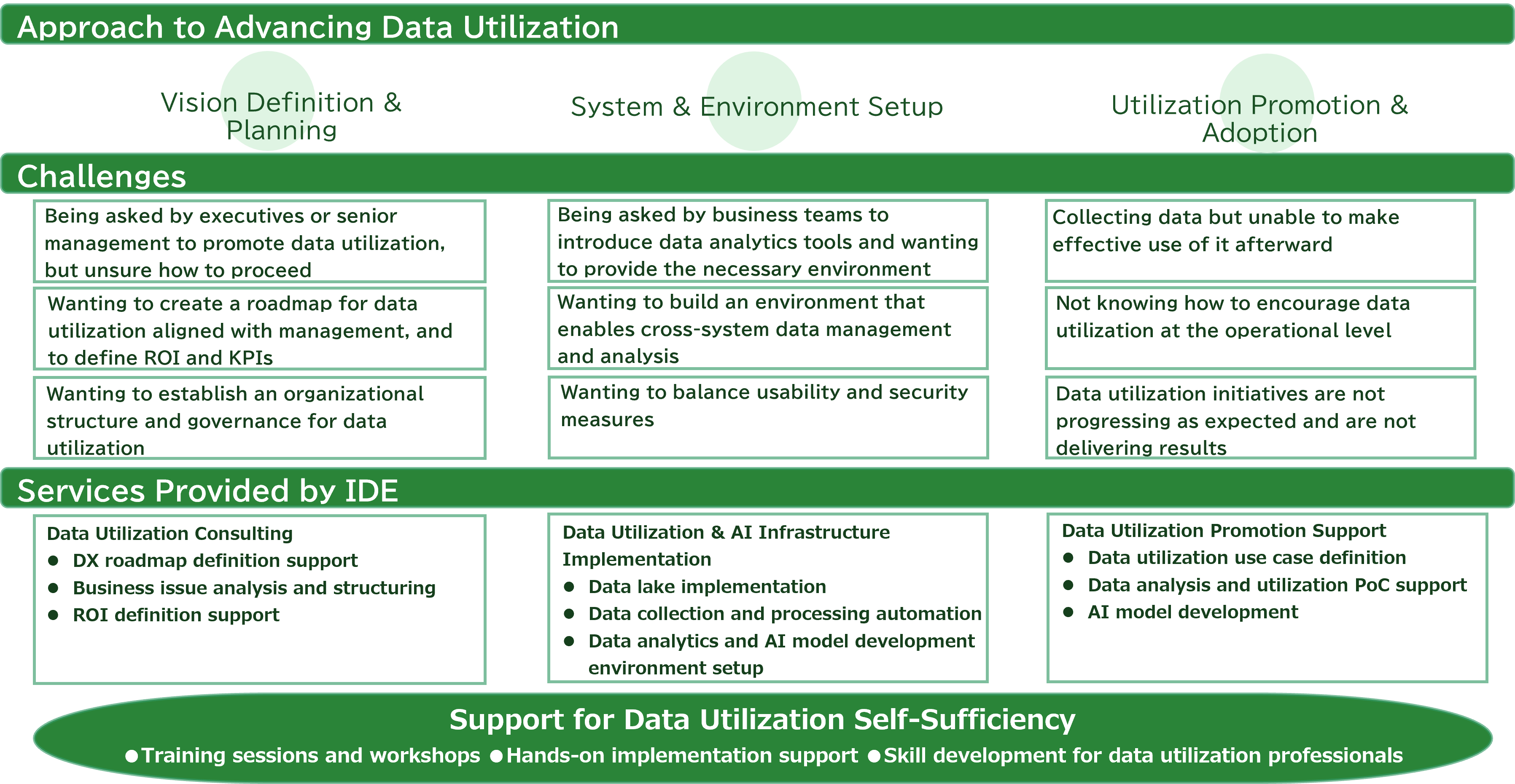
Data utilization platform initiatives are generally progressed through the following phases.
Key Features of Datawarehouse Implementation Support
01 End-user-led data search and transformation
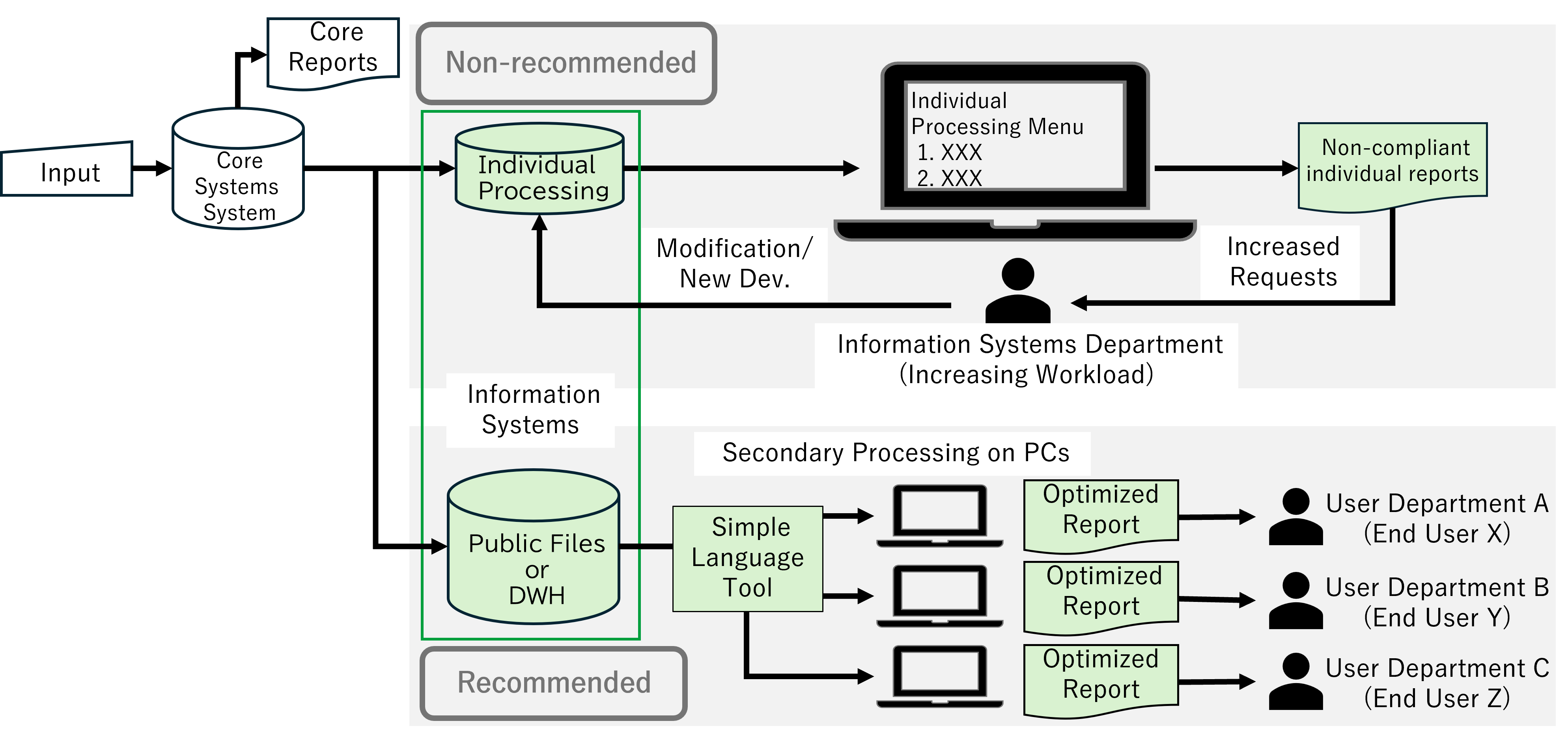
Under the EUD delivery model, there are two main approaches: individual processing and the data warehouse approach.Individual processing is suitable for fixed operations that require little to no modification or new development. However, it is not well suited to the European business environment, where EU regulations are frequently introduced, amended, or reinterpreted.
With a data warehouse approach, processing logic is not hard-coded around specific regulations or report formats. Instead, data is stored in an analysis-ready structure, enabling end users to independently search, extract, and transform data using their own criteria—such as by country, period, or regulation.
This allows regulatory reports and official submissions to be prepared flexibly and efficiently by business teams, without relying on system modifications.
02 A data platform resilient to EU regulatory changes
Within the Business-Led Automation Development (EUD approach), system architectures must be designed on the assumption that EU regulations will continue to evolve through new requirements, amendments, and changes in interpretation.A data warehouse keeps data as a shared foundational asset, rather than embedding regulation-specific logic within the system. As a result, the impact of regulatory changes can be localised, avoiding large-scale system modifications or redevelopment.
This enables continuous, stable compliance with EU regulations while maintaining system sustainability.
03 Reduced dependency on IT departments and vendors
By combining the EUD approach with a data warehouse architecture, organisations can reduce their dependence on IT departments and external vendors for regulatory responses and report creation.This not only improves response speed, but also helps eliminate development wait times and reduce coordination and implementation costs.