
However, a shortage of personnel handling trade operations is emerging as a challenge. International trade involves numerous processes from the shipper to the consignee, generating vast amounts of documentation and coordination tasks that demand significant time and effort. In this environment, operational efficiency is essential for enhancing corporate productivity and international competitiveness going forward.
The Challenges in International Trade Operations
In 2025, Sojitz Tech-Innovation, an IT subsidiary of the general trading company Sojitz, conducted a survey targeting over 2,000 practitioners engaged in trade operations, visualizing the challenges faced in trade administration at the operational level. (Source: Sojitz Tech-Innovation) According to the survey, 85% of practitioners responded that they “want to automate part of their work.” Furthermore, the results showed a particularly high proportion of automation needs related to document-related tasks.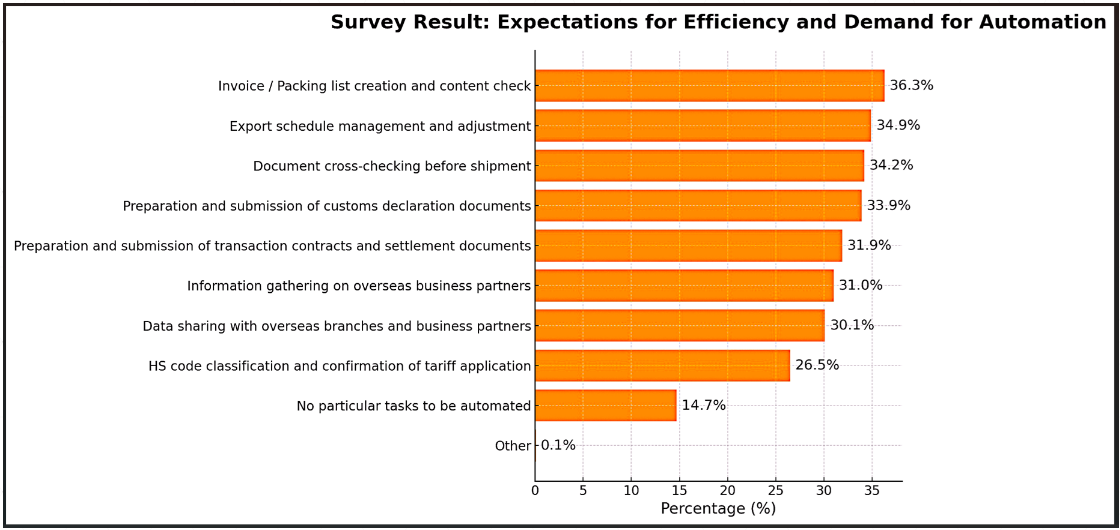
(Source: Sojitz Tech-Innovation Page 10)
Here, documents refer to invoices, packing lists, customs declarations, Bills of Lading, Certificates of Origin, and other paperwork created by shippers or forwarders to ensure goods clear customs smoothly.
Since they directly impact customs clearance, “creating customs documents” and “verifying them” are processes where mistakes are unacceptable. Furthermore, as mentioned at the outset, the number of import/export declarations is increasing, making this an area where both accuracy and operational efficiency are essential. On-site operations involve significant repetitive tasks related to these documents, indicating a high workload burden on personnel.
To address these challenges, utilizing the AI tool “Dify” can significantly reduce the operational burden.
Automating and Streamlining Trade Operations Using Generative AI and Dify
“Dify” is a tool that leverages large language models (LLMs) while enabling workflow automation. As a use case in trade operations, it can extract necessary data from documents like invoices and customs declarations using the LLM, then format and output this data in a standardized format. For workflow automation, it can incorporate processes that check document contents according to predefined business rules, enabling automatic verification of items such as product quantities, amounts, HS codes, and dates.Below is an overview of Dify's use cases for document-related tasks:
1. Input Data Acquisition
- Upload invoices or PL (PDF, Excel, CSV, etc.)
- Extract data from paper documents using OCR (Optical Character Recognition)
- Direct data retrieval from ERP/accounting systems via API integration
- Automatically categorize data into fields like “Item Name,” “Quantity,” “Amount,” and “HS Code”
- Standardize data according to user-defined formats (e.g., date formats, currency notation)
- Detect input errors, such as quantity discrepancies between invoices and PLs
- Verify HS code validity
- Reconciliation of amounts and line items
- Identification of violations against customs regulations (which vary by country)
- Required customs declaration forms (e.g., NACCS format, Import/Export Declaration for Japan, SAD form for EU)
- Can also convert to XML/CSV files for EDI or customs systems
- Embed workflow within the Dify app and notify status to communication tools like Slack/Teams
As an implementation case we are aware of, Company Z, which handles logistics/customs operations in the Netherlands, previously required significant manual data entry and verification, taking 3-4 hours for document creation. After introducing generative AI, this was reduced to 10-15 minutes, successfully cutting processing time by approximately 90%.
As described above, Dify is a highly effective tool for reducing the workload of trade operations.
If you have any questions regarding this article or are interested in the solutions mentioned above, please contact us via the link below.
Contact | ID Europe B.V. (idnet.co.jp)


